Fresh Approach to Education @ Greenbuild 2012

Feature image: 
Nils Kok presents at Greenbuild 2011 in Toronto

Heading into the 11th Greenbuild, our education program continues to evolve with a fresh approach to entertaining and motivating you inside the session room.

Check out some of the changes I’m most excited about:

  • Shorter education sessions = 60 minutes. In an effort to help you make the most of your experience, education sessions are now hour-long presentations. View the program »
  • read more

Plano Environmental Education Center: A City’s Symbol for Sustainability

Gary Olp, AIA, NCARB, LEED AP BD&C
President
GGO Architects

It’s curious how times change. During the ‘80s, I heard about how the city of Plano was a rapidly growing example of Dallas sprawl. It was looked upon as a scourge of urban revitalization. But by the millennium, Plano had evolved to become simply the northern edge of a growing greater Dallas metropolitan area.

And just as the city’s reputation changed in this context, so did its commitment to environmentally-friendly practices. This is the story of how a green building in Plano, TX has become a symbol for the city’s ever-increasing commitment to sustainability.
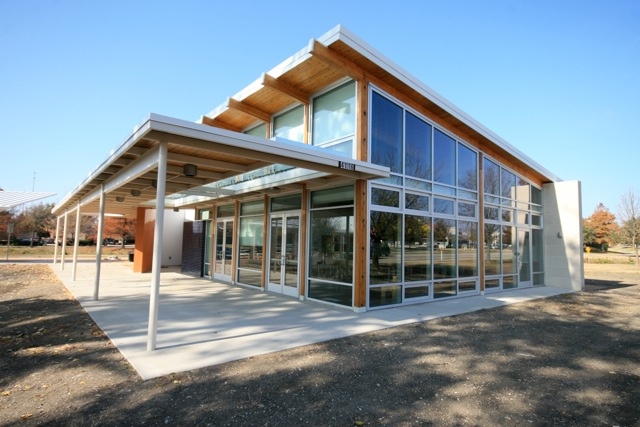
Plano Environmental Education Center. Photo Credit: Mark Olsen

The Vision

Flashback to the year 2000: As the city of Plano matured, conversations with city staff at local sustainable conferences and USGBC events evolved around the potential for a more sustainable approach for solid waste practices, water conservation and innovative municipal policies that would benefit Plano long term.

An early advocate, Nancy Nevil, Director of Sustainability & Environmental Services for the City of Plano, decided to take matters into her own hands and make a difference at the local level. Armed with a vision to reduce, reuse, and recycle, she groomed the support of the city’s elected officials and implemented automated recycling and household chemical collections programs that have became benchmarks for other cities throughout the state.

After years of trimming my trees and witnessing mountains of woody debris being collected and hauled off to the landfill, I was thrilled to discover that an outgrowth of Plano’s new program was the conversion of the collected debris into soil amendment products such as humus, mulch and compost. The city was marketing those products to consumers as a revenue stream! This was the most realistic example of closed loop thinking I had ever encountered. Soon afterward, Nancy made me aware that they were also crushing collected glass and selling it as billet to local glass product manufacturers.

Novel thinking and committed action! In that moment the concept of thinking globally and acting locally became clear.

The Building

Nancy’s team built a small backyard composting demonstration garden that grew in popularity with volunteers and residents, eventually evolving into the Environmental Discovery Center. A typical Saturday featured hands-on master gardener classes, master composting, water conservation, xeriscape landscaping, beneficial insects identification, organic pest control and recycling classes outdoors. As a consequence of their passion, City Council ultimately tasked Nancy’s department with educating the community on sustainability and incorporating sustainable best practices into city government, local businesses and the daily lives of its residents. The mission and the vision just got bigger! The focus of the educational effort was expanded to include energy conservation, air quality, water conservation, native planting materials, pest control, etc.

Plano Environmental Education Center.
Photo Credit: Mark Olsen

Ms. Nevil and her staff soon recognized that to implement this environmental mission effectively, they needed to encourage Plano residents of all economic levels and diverse cultural backgrounds to see, touch and experience a green building. “The only way for our citizens to understand the value of green buildings and their triple bottom line benefit was to provide this experience – by creating a building for them!”

The finished facility – the LEED Platinum Plano Enivronmental Education Center – displays dynamically how to integrate sustainable features and actions into the homes and businesses of the community’s residents.

It’s not surprising that one of the most popular aspects of the building is that all of the stormwater runoff is contained on site. Our region is reeling from the effects of extreme summer heat, extended drought conditions and current municipal water restrictions. Residents are delighted to learn that 25,000 gals of rainwater are harvested from every square inch of the roof and shade canopies and recycled first as flush water for the toilets, then to irrigate the living roof and finally to water the native demonstration landscape that envelopes the facility.

Every aspect of this facility was designed as an educational tool to highlight and celebrate sustainable features with a simplicity and friendly practicality that informs the cities’ diverse multicultural residents that environmentally responsible actions are not difficult to implement and are easy to do. Plano’s local leadership with this green building is already having an influence on economic and environmental actions by citizens and businesses alike to save energy, create jobs, and restore the local environment.

LEED Is Private, Voluntary, Transparent and Democratic

Feature image: 

Washington, DC – (July 18, 2012) – The U.S. Green Building Council (USGBC) today applauded the creation of the American High-Performance Buildings Coalition by the American Chemistry Council and others, noting that, after 20 years, it was significant that the representative groups were finally engaging in conversation about the critical importance of green, high performance buildings for America. In response to the announcement of the new coalition, Roger Platt, Senior Vice President of Global Policy and Law at USGBC released the following statement:

read more

Who’s Coming to Greenbuild 2012?

Feature image: 
Greenbuild 2012 speakers: Mika Brzezinski and Joe Scarborough of “Morning Joe”;

Four IMEX Green Meetings Awards. Tens of thousands of attendees. Greenbuild is not just an event, but the award-winning tent revival for the most passionate and innovative leaders of the green building movement. Can you believe it’s just a few months away? This year, at the 2012 Greenbuild Conference and Expo, we’re expecting over 35,000 attendees from every facet of the green building sphere to join us at the Moscone Center in San Francisco, Calif. for the largest Greenbuild event to date.

read more

Who’s Coming to Greenbuild 2012?

Feature image: 
Greenbuild 2012 speakers: Mika Brzezinski and Joe Scarborough of “Morning Joe”;

Four IMEX Green Meetings Awards. Tens of thousands of attendees. Greenbuild is not just an event, but the award-winning tent revival for the most passionate and innovative leaders of the green building movement. Can you believe it’s just a few months away? This year, at the 2012 Greenbuild Conference and Expo, we’re expecting over 35,000 attendees from every facet of the green building sphere to join us at the Moscone Center in San Francisco, Calif. for the largest Greenbuild event to date.

read more

Who’s Coming to Greenbuild 2012?

Feature image: 
Greenbuild 2012 speakers: Mika Brzezinski and Joe Scarborough of “Morning Joe”;

Four IMEX Green Meetings Awards. Tens of thousands of attendees. Greenbuild is not just an event, but the award-winning tent revival for the most passionate and innovative leaders of the green building movement. Can you believe it’s just a few months away? This year, at the 2012 Greenbuild Conference and Expo, we’re expecting over 35,000 attendees from every facet of the green building sphere to join us at the Moscone Center in San Francisco, Calif. for the largest Greenbuild event to date.

read more

Think and Be Greener: A Visit to Woodland Hill Montessori School

Jodi Smits Anderson
Chair
USGBC NY Upstate Chapter

What would you do if you found yourself in front of an audience of 20 kids, all convinced they know it all, yet totally open to new thoughts and ideas? If you were bold and a bit naïve, you might try to teach them about the triple bottom line, only to be blown away by their reception of the concept.

I had the opportunity to teach the middle school kids of Woodland Hill Montessori School about sustainability after complaining one too many times about the Styrofoam cups at their monthly coffeehouse fundraiser. Rather than accepting my offer to donate paper cups, one teacher conceived a greener, more dynamic alternative, and I was fully game to partake.

I began with Annie Leonard’s appropriately inflammatory short film about our consumer culture, “The Story of Stuff,” which prompted an engaging discussion about what the students’ families purchase and how those choices affect our world—including other people and the built environment, as mankind and nature are not independent.

Greening your computer: The students suggested that old computers could always benefit from redecoration with stickers. (Source: Phil Hawksworth, Flickr)

We then considered an example: How can you be a little greener in buying a new computer? Ideas flooded the discussion as if we were deciding where to eat ice cream. Laptops take less energy and are smaller! Buy one with a take-back policy! Be sure to clean out and maintain your computer! Buy from a local company! Buy a refurbished one! When it seems old, decorate it with stickers instead of buying a newer, prettier one that works the same way! I need to learn the last one.

The point was made. The only wrong answer is: Don’t ask any questions! If you want to be greener, all it takes is training yourself to think—about the purchases you make; about the spaces you are designing; about how you are doing something and if its working for you, your wallet (long-term) and the planet. “Think and be greener” is the motto I tried to teach.

Watch my recent TEDxTalk for the whole story, including how the students applied what they learned to their coffeehouse fundraiser.

Greener every day.

Healthy, Sustainable Interior Design: A Conversation with ASID

We’re surrounded by interior design. Take a look around you: For those of you reading this blog from your office, coffee shop down the street, or living room at home, everything from your overhead lighting to flooring represents a design decision. Given that we spend upwards of 90 percent of our time indoors, these decisions matter – and can have profound effects on our health and the environment.

Sustainable interior design continues to be a key pulse of LEED – and who better to discuss the industry than the the American Society of Interior Designers (ASID)?

We caught up with Randy Fiser, Executive Vice President and CEO of ASID, to get his take.

Randy Fiser, ASID

ASID has been involved in a variety of sustainable design initiatives. Why does the organization deem it important to get involved in this space? What does sustainability mean to ASID?

Randy Fiser: Because people ultimately spend most of their time indoors, interior design plays a significant role in helping to create functional spaces that improve the human experience and our everyday interactions with our environments. Sustainability is an essential part of the built environment, but we believe that its ultimate goals and outcomes should address both the impact on bottom-line and the people who live and work in those spaces.

Why is green interior design important? How does it impact occupants and the environment?

RF: One of the most important aspects of sustainability is health – health of the indoor environment, of the occupants, of the materials. Interior designers offer specialized knowledge of interiors materials and FF&E (furniture, fixtures and equipment) that promote good indoor air quality, are toxin-free, and are water/energy-efficient. For example, formaldehyde is a known carcinogen that is ubiquitous in furniture and cabinetry. Understanding the health implications of this substance and how to source formaldehyde-free products demonstrates the value interior designers bring to the table.

USGBC’s green office digs in Washington, DC

How important is it for interior design professionals to understand the concepts of sustainability?

RF: ASID recently issued our Facts & Figures report which cites that on average, interior designers specify products in nearly 9 out of 10 projects in both residential and commercial projects. This figure illustrates the impact that interior designers have on the built environment. For example, consider the issue of water conservation. At least 2/3 of the U.S. has experienced or is expected to experience water shortages. Reducing the amount of water we use is imperative and one of the easiest solutions is to improve water efficiency of kitchen and bath fixtures and appliances. If every household in America installed a water-efficient faucet, the U.S. could save 60 billion gallons of water annually. From the commercial perspective, a small office with as few as 10 employees can save about 69,000 gallons of water and $420 in water utility bills in a single year if they replace just one toilet. Scale that up to a 500-room hotel and you get a sense of the impact interior designers have on their clients’ pocketbook as well as the environment. Specifying water-efficient fixtures is just one example of something interior designers do on a daily basis that makes a real impact one project at a time.

Can you highlight a green interior space or project that you find particularly inspiring?

RF: Prior to joining to ASID, I worked as an advisor for the Make It Right Foundation that led the development of the world’s largest LEED Platinum residential community in New Orleans’ Lower Ninth Ward. It was through my experience there that I witnessed first-hand the power and impact that sustainable design can make on the well-being of a community. The residents not only benefitted from safe and healthy homes, but also significantly reduced utility expenses. In some cases, residents went from electric bills that exceeded $300 a month in their old homes, to bills that averaged less than $50 per month in their new homes. The benefits of sustainable design on the environment are evident, but the potential cost savings provides significant economic advantages and increased opportunities for families and communities to allocate more money to essentials like education, groceries and healthcare.

What’s the future for green interior design?

RF: Even though sustainability has made significant inroads into the everyday design vernacular, we need to do much more for it to become common practice. One of the more impactful education sessions at NeoCon this year focused on developing industry-wide models for a sustainable future. We believe that an integrated model of collaboration and a holistic approach that brings builders, designers, architects and the occupants together is integral to the future of sustainable design and we look forward to being a key partner in this quest.