Does your building exceed the baseline energy efficiency performance required by your local code? If so, it may be able to meet the more stringent requirements of the New Buildings Institute’s stretch building code strategies.
Author: LEaD Blogger
-
Choosing the Right Sustainable Building Materials for Your Next Project
Are you ready to incorporate sustainable building materials into your next project? Choosing construction materials that are derived from readily renewable resources like bamboo poles, thatch, reeds, eucalyptus, and cork allows you to add environmentally friendly flair to your project without sacrificing quality, style or value. However, to get the most out of sustainable construction materials, you’ll need to choose the right materials for your purposes.
Understanding The Different Sustainable Building Materials
When you choose a building material, you identify your needs, research your options, and select. The same method works when you’re selecting eco-friendly building materials. Determine your practical requirements regarding factors like durability, strength, aesthetic appeal and price. Will you use the materials indoors, outdoors or a combination of both? Then explore the many sustainable materials available to pinpoint which might meet your needs before choosing. What are some examples of durable building materials that might work in your next project?
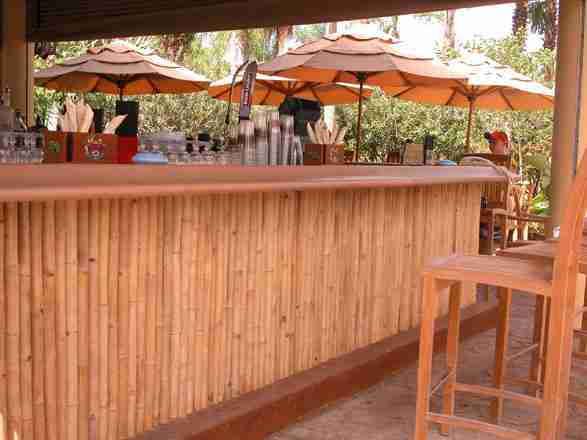
Solid Bamboo Poles
Solid bamboo poles offer an ideal blend of beauty and strength, making them perfect for construction projects. This versatile bamboo has an atheistic appeal With gorgeous hues ranging from deep, rich tans to softer, honeyed shades. Thanks to its dense wall thickness, it also offers impressive strength and durability. This natural bamboo product can be used indoors or outdoors. You can choose from sanded, natural, finished and half-rounded poles. Pressure-treated and fire-retardant versions are also available.
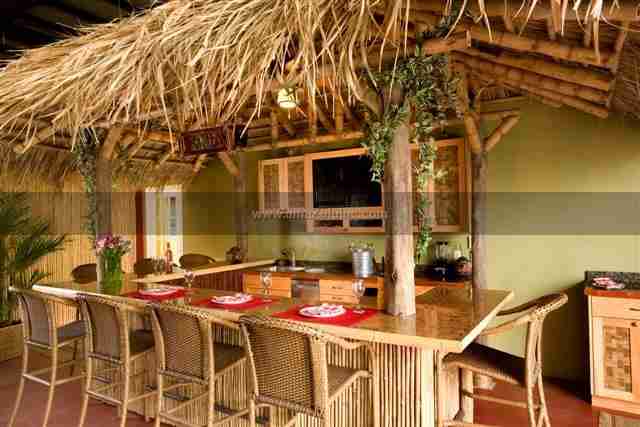
Thatch Roofing
Of all the tropical roofing products available, thatch roofing is our favorite. Thatch roofing delivers a delightfully relaxed ambiance. It also offers more. Thatched roofing is often used as a decorative feature or it can be quite functional and suitable for a wide array of applications. Thatch roofing is an environmentally friendly way to lend personality to an indoor or outdoor space while also enjoying some significant practical benefits. Thatched roofing requires little maintenance and can be treated with a fire retardant to enhance safety. It’s also thermally efficient. Because it provides a superior mix of protection and ventilation, the areas that it shelters remain cooler and more comfortable. Natural thatch roofing will transport your guests to a tropical paradise. But don’t forget about synthetic thatch roofing. Synthetic thatch roofing is ideal, especially if you want a maintenance free option for an outdoor area.
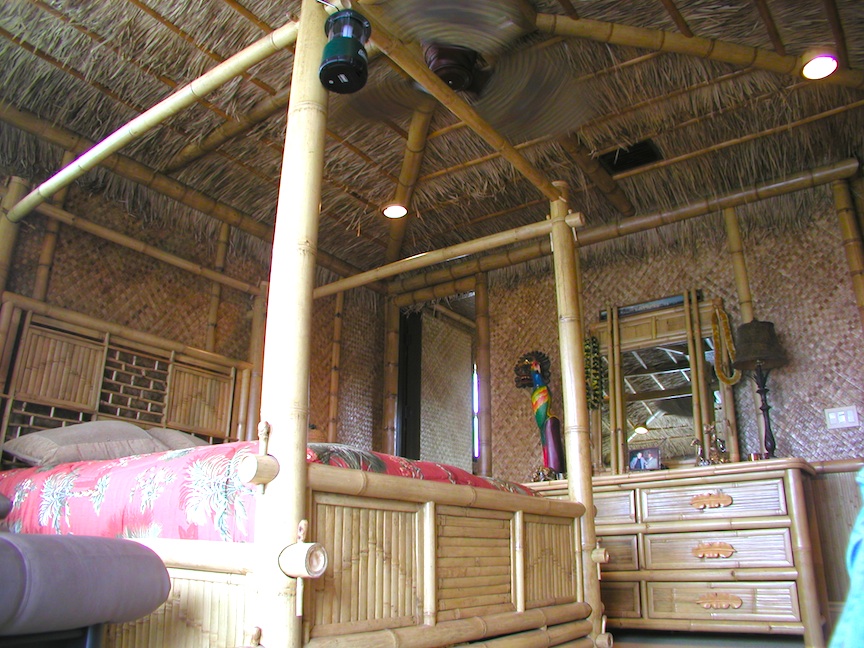
Reed Ceiling Boards
With reed ceiling boards, there’s no reason to settle for a boring ceiling. Crafted by gluing individual reeds to a backing board, these panels shift in color between shades of tan, beige and green with some brown mottling that adds a little visual spice. These decorative boards generate a natural and textured tropical vibe that delights the senses. Fire-retardant treatment is available.
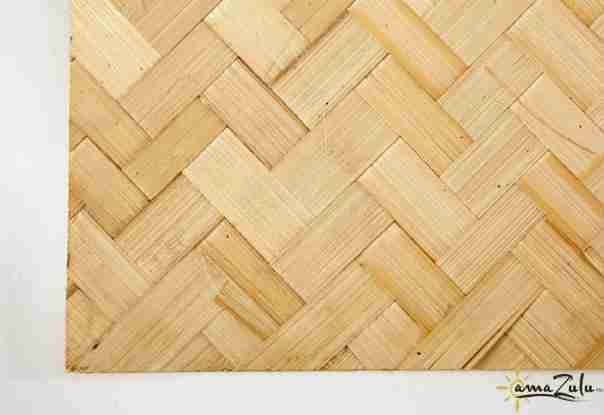
Woven Bamboo Plywood
Woven bamboo plywood merges the honey tones with some terrific texture to create something extraordinary. Narrow strips of the interior of a bamboo pole are pressed together to produce a thin, flexible sheet of plywood with a distinctive herringbone pattern. This decorative plywood shines whether you employ it as a bamboo matting wall covering for one or more walls, use it as wainscoting, or apply it as a ceiling treatment.
If you’re unfamiliar with sustainable construction products, enlisting the aid of an experienced supplier can be invaluable. At amaZulu Inc., our team sources materials from carefully vetted suppliers from around the globe to deliver a dynamic menu of high-quality, sustainable building materials. We have had the privilege of working with countless architects and builders to create a tropical paradise in any setting. It will be our pleasure to share our experience with you about your options and assist you with your selection process.
Contact us today at 877-243-5309 to speak with one of our designers to learn more using sustainable building materials in your next commercial project.
-
How Carbon Dioxide Becomes Ethanol
Researchers accidentally discover new waste-to-fuel technology.
-
Learn More about Green-e Standards in Your Region
New certification framework provides criteria for location-specific green energy.
-
Puerto Rican Farm Saved By Solar Panels After Hurricane Maria
Farmer hopes Puerto Rico will invest more in renewable energies.
-
Cooking Oil and Tires: The Future of Biofuel?
New process opens up the potential for inexpensive fuel production.
-
Massachusetts leads by example at Greenbuild
Feature image:
The USGBC Massachusetts Chapter has been working hard all year, helping to build the road to Greenbuild. Boston first served as the host city for Greenbuild in 2008, and USGBC Massachusetts is excited to host in 2017 for this second visit.
As the number one state for LEED buildings in the U.S., with more than 24 million square feet certified in 2016 alone, Massachusetts is a leader in the green building industry. The state has been growing fast in its LEED certifications, moving from number five nationwide in 2014 to number three in 2015, before topping the list in 2016.
While green building professionals from all over the world convene in Boston, the city will be showing off its sustainable features and LEED buildings on Greenbuild tours, as well as offering expertise at education sessions about strategies that have made Massachusetts a greener, healthier place to live and work.
The next generation of green builders
Focusing on growing the green building industry through education and equity, the USGBC Massachusetts community initiated the Greenbuild Boston Legacy Project, currently under way at Madison Park Technical Vocational High School. Dubbed the Green Building Tech Program, this project will create awareness of green building technologies and the green trades, such as facilities management, electrical and plumbing skills, to help close the “green gap” that exists for the next generation of building operators.
Another way the community is reaching out to students is through a free workshop at Boston University, “How to Network at Greenbuild and Build Your Career in Sustainability.” Local students and emerging professionals can brush up on their skills ahead of Greenbuild’s many opportunities to connect.
Green building tours
A wealth of walking tour options is available at Greenbuild: The 2017 slate covers 80 sites throughout Massachusetts, across 30 different tours. In these tours, attendees explore exciting places ranging from higher education facilities to sports venues to local neighborhoods. There’s even a harbor tour, at Boston’s rejuvenated Seaport District. Here is just a sampling of what you can see outside the conference center:
- Monstah Green—Mon., November 6, 8 a.m.–12 p.m.
- Rebuilding Boston—Mon., November 6, 1–5 p.m.
- Seaport Sustainability—Fri., November 10, 1:30–5:30 p.m.
- Creating a Sustainable Community from Scratch—Sat., November 11, 8 a.m.–12 p.m.
Explore more Greenbuild tours.
Education sessions
Attendees at Greenbuild have the choice of a broad array of sessions and workshops. Among them are many Boston-area projects, collaborations and case studies from which green building professionals can take away insights and strategies to help them succeed in their own localities. Here are just a few:
Creating Disaster-Resilient Housing in East Boston—Thurs., November 9, 3–4 p.m.
This session showcases an East Boston waterfront apartment building designed for resilience against storm surges, sea-level rise and flooding in a site particularly vulnerable to climate change. Learn about Boston’s zoning code “Green Buildings and Climate Change Preparedness and Resiliency Policy,” and how the project was “built to last” rather than “built to code.”
Social Equity at Work in Roxbury and Dorchester—Tues., November 7, 2:45–3:45 p.m.
The session will focus on achieving the LEED Social Equity in the Community credit, describing the process from the perspectives of the developer and the community advocate and discussing effective community engagement in the building development process. Attendees will learn how to avoid displacement, enhance access to public transportation and engage community through art and culture.
Renewable Energy: Innovation Through Collaboration—Thurs., November 9, 3–4 p.m.
Explore the lessons learned from a joint power purchase agreement model implemented by the Massachusetts Institute of Technology (MIT), Boston Medical Center (BMC), and Friends of Post Office Square. The team bought electricity from a large new solar power installation, adding carbon-free energy to the grid and demonstrating a partnership model for other organizations in climate-change mitigation efforts.
See more Boston-related sessions by using the keyword search field in Greenbuild’s Sessions page.
-
WaterSmart and WaterBuild partner on sustainable water use series
Feature image:
USGBC has partnered with the WaterSmart Innovations Conference and Exposition (WSI) to accelerate sustainable solutions for the water and building industries. This collaboration has made possible a two-part education series hosted at WSI and the WaterBuild Summit at Greenbuild Boston.
The sessions, “Towards Net Zero Water in LEED: A Forum on Whole Project Water Use,” explore LEED v4’s newest pathway for teams to demonstrate reductions in water consumption, the pilot credit Whole Project Water Use Reduction.
Depending on the building type and use, LEED may not previously have addressed all water use within a project boundary. This pilot credit rewards projects that take a holistic approach to water management and reduce total potable water consumption within a project boundary.
Participants at the session will hear from USGBC staff and LEED project teams how the whole-building water balance methodology provides projects with diverse water needs a practicable solution for achieving LEED points in the Water Efficiency credit category and how it aligns with the LEED v4 rating system’s focus on performance.
Part I at WaterSmart
Part I of the series, hosted at WSI, will introduce the whole project methodology and project types using the pilot credit. The WSI session will not require a conference registration and will be held Wed., October 4 in the South Point Hotel and Conference Center.
Taking place October 4–6, the 10th annual WSI will feature more than 100 professional sessions, an expo hall showcasing water-efficient products and services and technical tours to venues illustrating Southern Nevada’s commitment to water efficiency.
Part II at WaterBuild
Part II of the series, hosted at the WaterBuild Summit at Greenbuild on November 7, will feature case studies presented by sustainability practitioners working on hospital, retail and data center projects. Attendees will learn the value of of whole-building water balance modeling as a design and operations tool and have the opportunity to discuss water efficiency technologies and strategies that can be implemented at the building scale.
The summit will explore ways in which the green building industry can spur more meaningful transformation in important areas of water quality, access, efficiency, resilience and abundance. It will focus on innovative infrastructure solutions that equip communities to resiliently respond to environmental challenges and stresses.
-
5 growing careers in the green job market
Feature image:
On the road to Greenbuild 2017 in Boston, we take stock of the contributions that green buildings and associated sustainable markets have had in driving economic growth—and look toward the careers that will continue to drive marketplace transformation.
Green construction is projected to account for more than 3.3 million U.S. jobs and to generate $190.3 billion in labor earnings between 2015 and 2018, according to the 2015 Green Building Economic Impact Study.
We know that architects, building engineers and contractors play a huge role in ensuring sustainability, but there are many other roles that make a difference in achieving environmental, economic and social progress. Here are some of the top green jobs that are expected to grow in the next seven years, according to the Bureau of Labor Statistics.
1. Wind turbine service technician
Projected growth: 108 percent
Wind turbine technicians work on all aspects of the wind system, including turbines, controls and ancillary support equipment. They are expected to climb towers and platforms at least 85 feet high. They install, inspect, diagnose and repair turbines and components and review related manuals, blueprints and schematic diagrams to maintain a highly automated system.
Example job titles: wind energy mechanic, wind turbine mechanic, wind turbine technician.
2. Solar photovoltaic installer
Projected growth: 24.3 percent
Solar photovoltaic installers assemble, install or maintain solar photovoltaic (PV) systems on roofs or other structures in compliance with site assessment and schematics. Their responsibilities include assessing the environment and mitigating any hazards associated with installation, along with sealing the systems against weather. This often includes electrical work and testing.
Example job titles: solar technician, PV testing technician, solar energy technician, solar field service technician.
3. Environmental engineer
Projected growth: 12.4 percent
Environmental engineers are involved in efforts to improve recycling, waste disposal, public health and water and air pollution control. They also address global issues, such as unsafe drinking water, climate change and environmental sustainability.
Example job titles: air pollution control engineer, environmental remediation engineer, hazardous substances engineer, pollution control engineer, soil engineer, waste management engineer, water treatment plant engineer.
4. Construction and building inspector
Projected growth: 8 percent
Construction and building inspectors ensure that construction meets local and national building codes and ordinances, zoning regulations and contract specifications. Inspectors generally perform an initial check during the first phase of construction, follow-up inspections throughout and a final comprehensive inspection.
Example job titles: architectural inspector, bridge inspector, building code inspector, construction inspector, electrical inspector, plumbing inspector, plumbing inspector, residential building inspector.
5. Building custodian
Projected growth: 5.8 percent
Custodians work to make sure that buildings are neat, clean and safe. They also may oversee building security, window cleaning and minor building maintenance and repairs. Custodians implement a building’s green cleaning program, ensuring that safe and environmentally friendly cleaning products and procedures are used and that waste is disposed of properly.
Example job titles: cleaning and maintenance worker, custodial worker, floor cleaner, janitor, office cleaner, school custodian, window washer.
Learning at Greenbuild
To learn more about careers and sectors in the green building industry and for great networking opportunities, join us at Greenbuild 2017 in Boston, India and China. In Boston, don’t miss the career-related events below:
Course: Internships: Creating a Talent Pipeline for Green Industries
Thurs., November 9, 1–2 p.m.
This session will cover the topic of internships from the perspectives of interns, employers and a unique state-led initiative to support the clean energy industry through on-the-job training. Learn how to structure a successful internship program, discover the job prospects in sustainability and discuss lessons learned from both attendees and presenters.
Course: Staying Nimble in Your Sustainability Career
Thurs., November 9, 5–6 p.m.
Learn how to adapt to an ever-changing landscape in green building and a steady flow of new technologies, rating systems and opportunities. Top leaders in the industry share how they grow their technical expertise, build relationships and catalyze market transformation.
-
LEED and leadership: Building a greener future in China
Applicable country:ChinaFeature image:
China’s commitment to green building, stated explicitly in President Xi Jingping’s 13th Five Year Plan (FYP), is significant. The government of China sees clearly the importance of building sustainably. As such, the nation has rapidly moved to the forefront of sustainable development.
With the backing and support of visionary companies, Chinese business leadership is also committing to greening every aspect of its ongoing developments—from commercial offices and industrial centers to high-rise residential communities to the retail, recreation and transportation structures that support them.
USGBC is delighted that LEED has played a significant role in helping China’s leaders realize important benchmarks in green building, and we are helping China achieve key objectives in its ambitious 13th FYP. Through hard work, sound investment and dedication to the sustainability of our planet, China has realized some tremendous milestones using LEED.
Now, as we move closer to the October 17 opening of the inaugural Greenbuild China, we spotlight 10 of those breakthrough events for you:
- April 2013: Shanghai EXPO UBPA Development becomes the first LEED Platinum project certified under Neighborhood Development in greater China.
- September 2013: Haworth Showroom in the LEED Platinum Parkview Green building in Beijing becomes the world’s first LEED v4 project.
- January 2014: The first LEED home in China is announced.
- August 2015: Nike’s Logistics Center becomes the first LEED Platinum warehouse in China.
- December 2015: The world’s second largest building, Shanghai Tower, achieves LEED Platinum certification.
- May 2016: The Glumac Shanghai Office T1 becomes the first LEED Platinum building certified under LEED v4 not just in China, but also in East Asia.
- March 2017: China certifies its 1,000th building using LEED.
- March 2017: China is named the largest market for LEED outside the United States.
- April 2017: Parkview Green is the first project in China to adopt Arc.
- June 2017: Johnson Controls’ Asia Pacific Headquarters achieves both LEED Platinum and EDGE certifications.
Though these are just 10 of China’s many LEED milestones, they represent important green building events for an ascendant country that is moving rapidly to address critical social and environmental challenges. If you would like to learn more about the people and projects that are helping China to sustainably meet its present and future development needs, please join us in Shanghai for Greenbuild China. On October 17 and 18, come see how China’s green building industry and the LEED rating system are aligning to build a more sustainable future for all.